Home / Surroundings / Things to see in Pietrasanta
Things to see in Pietrasanta
The city of marble and sculptors: the square, the churches, the Bozzetti museum, Botero’s frescoes, the workshops and a one-day itinerary.
In this guide
- Why it is called Little Athens
- Summer events and the Mitoraj Museum
- Piazza del Duomo
- Sant’Agostino and the Bozzetti museum
- Via Mazzini and Botero
- Sculptures around town
- Workshops and foundries
- The Rocca di Sala
- Museums
- Pietrasanta in a day
- Through the year
- Around Pietrasanta
- Practical tips
- Frequently asked questions
At a glance
- You can explore the historic centre on foot in half a day: everything revolves around Piazza del Duomo.
- Don’t miss: the Cathedral of San Martino, the Museo dei Bozzetti, Botero’s frescoes in the Misericordia church and the view from the Rocca di Sala.
- Pietrasanta is the city of sculptors: marble workshops and bronze foundries are still at work today, and some can be visited.
- Monumental sculptures are everywhere, in the squares and on roundabouts: an open-air park.
- The sea is at Marina di Pietrasanta, the town’s coastal district, a few minutes’ drive away.
- In summer: the DAP Festival (dance) and Pietrasanta in Concerto (classical music). Since June 2026 there is also the Mitoraj Museum.
Why it is called Little Athens
Pietrasanta is a small walled town at the foot of the Apuan Alps, in the heart of Versilia. It was founded in 1255 by Guiscardo da Pietrasanta, podestà of Lucca, and takes its name from him. Its nickname, “Little Athens”, comes from marble: the Apuan quarries are a few kilometres away, and for centuries sculptors from all over the world have come here to have their models translated into stone and bronze by the town’s craftsmen.
In the 20th century came Fernando Botero, Igor Mitoraj and many others. Some made their homes in Pietrasanta, and their works have stayed in the squares. Today the centre is a succession of galleries, workshops and outdoor sculptures, at the pace of a small provincial town: you explore it on foot, unhurried, and in the evening the square becomes the drawing room of Versilia.
Here is what to see and do in Pietrasanta, in the order we suggest to our guests: start from the square, take in the churches and museums, step inside a workshop and finish with the sunset from the Rocca.
Summer events and the Mitoraj Museum
The DAP Festival (Danza in Arte a Pietrasanta) brings contemporary dance into the town’s halls, cloisters and squares, in dialogue with the visual arts. The 2026 edition, the tenth, ran from 27 June to 11 July with 14 international performances, at the Cloister of Sant’Agostino, the Mitoraj Museum and the Versiliana stage. The festival usually takes place between late June and early July.
Pietrasanta in Concerto is the classical music festival created and directed by the violinist Michael Guttman: summer evenings of soloists and ensembles, mainly in the Cloister of Sant’Agostino, with some events in Piazza del Duomo too. The 2026 edition ran from 21 July to 2 August, with pianist Martha Argerich on two evenings. Dates and programme change every year: check them before booking.
The Mitoraj Museum opened on 6 June 2026 at Via Oberdan 35, in the former municipal market: it is the first museum devoted entirely to the sculptor Igor Mitoraj. The permanent collection includes 69 works in marble, bronze and resin, as well as jewellery, donated by Jean-Paul Sabatié, the artist’s heir. Opening times are on the museum website.
Piazza del Duomo
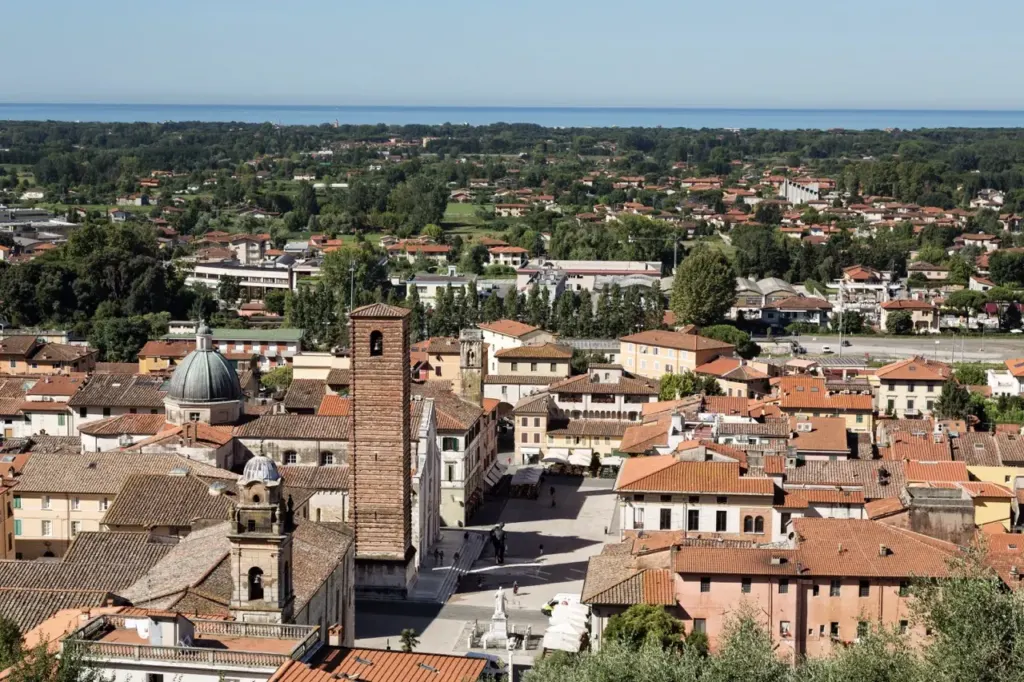
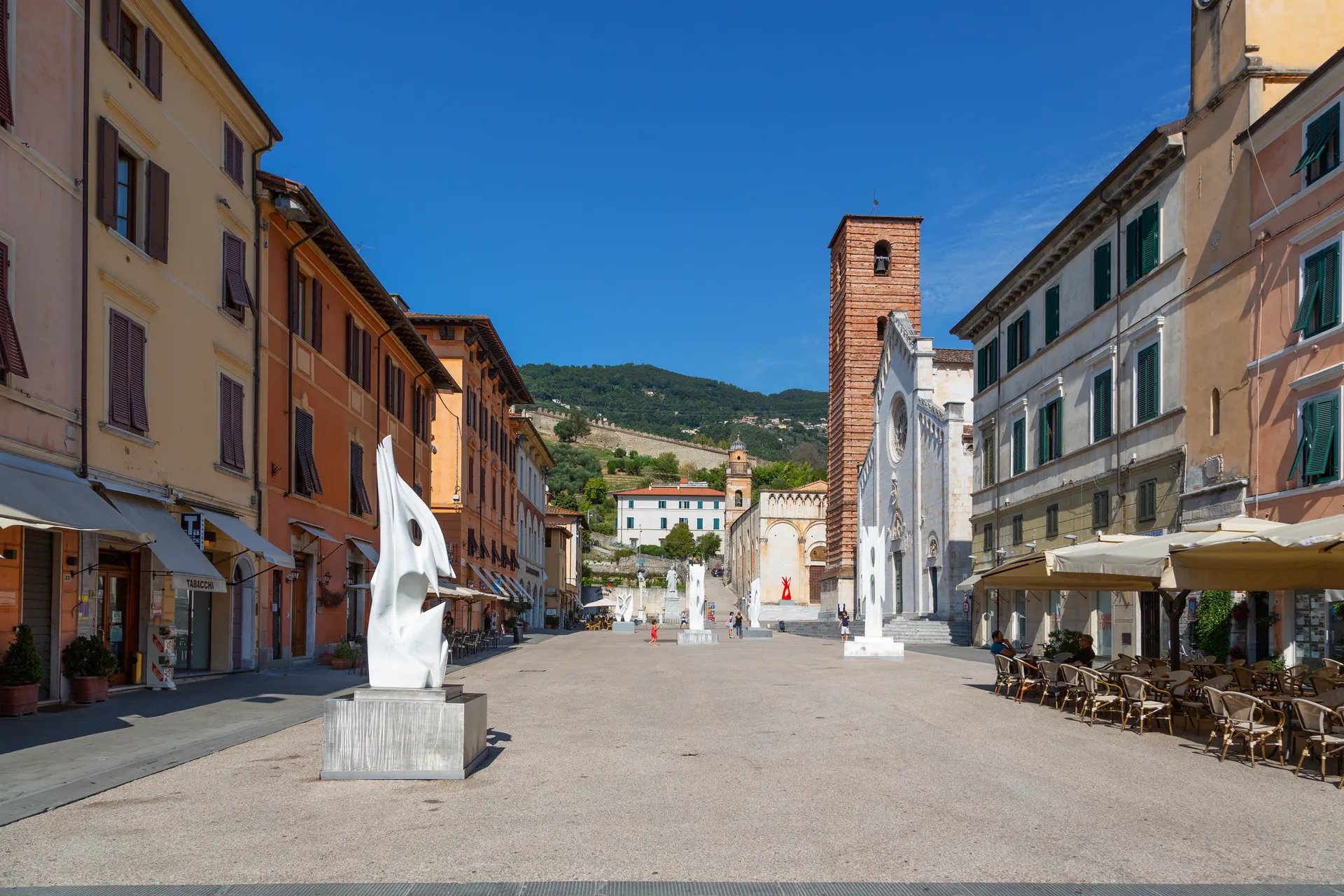
Piazza del Duomo is the heart of Pietrasanta: long and open, closed off at the top by the hill of the Rocca. It almost always hosts a large contemporary sculpture, which changes with the exhibitions: the quickest way to understand what kind of town Pietrasanta is.
The Cathedral of San Martino

The white marble façade of the Cathedral of San Martino, with three portals and a great rose window, is the backdrop to the square. Inside, the three naves are divided by columns of local marble; the works include the marble pulpit and the panel painting of the Madonna del Sole. Entry is free; during services it is best to come back later.
The bell tower
The bell tower of Pietrasanta cathedral is in bare brick: the planned marble cladding was never completed, and that is exactly what has made it one of the symbols of the town.
Torre delle Ore, Marzocco and Baptistery
Also overlooking Piazza del Duomo are the Torre delle Ore, with the civic clock, and the Marzocco column, the lion bearing the arms of Florence that recalls the period of Florentine rule. The Baptistery, to the right of the cathedral, holds a marble font.
Sant’Agostino and the Museo dei Bozzetti
On the opposite side of the square is the church of Sant’Agostino, with its marble façade and a long history as a monastery. Today the church hosts exhibitions and concerts, and the lunette above the portal holds a bronze Annunciation by Igor Mitoraj.
In the former monastery, around the cloister, is the Museo dei Bozzetti, the place that explains Pietrasanta’s work better than any text. It collects the sketches and models of hundreds of Italian and international artists who made their works in the workshops of Versilia. Seeing the plaster model next to photos of the finished piece, perhaps standing in a square on the other side of the world, shows you the journey a sculpture makes here. The municipal library is in the same complex.
Via Mazzini and Botero
Via Mazzini is the main street of central Pietrasanta, lined with shops, galleries and cafés, and leads straight to the square. At its start, towards Piazza Crispi, stands the Peace Frame by the American artist Nall: a large bronze and mosaic frame that frames the street. Everyone stops for a photo, and rightly so.
Halfway along is the stop many people miss without knowing it: the Misericordia church. Inside, on the walls, are two large frescoes by Fernando Botero, the Gate of Paradise and the Gate of Hell, painted by the artist who lived and worked in Pietrasanta for many years. Entry is free and the visit takes ten minutes; opening times vary with the season. All the places linked to the artist in town are in our guide Botero in Pietrasanta.
Sculptures around town
Pietrasanta is a museum spread across the town. The International Park of Contemporary Sculpture brings together dozens of monumental works placed in squares, on roundabouts and in gardens, from the historic centre to the seafront at the Marina. Among the best known is Botero’s Warrior, at the entrance to town, alongside works by Mitoraj, Cascella, Folon, Yasuda and others.
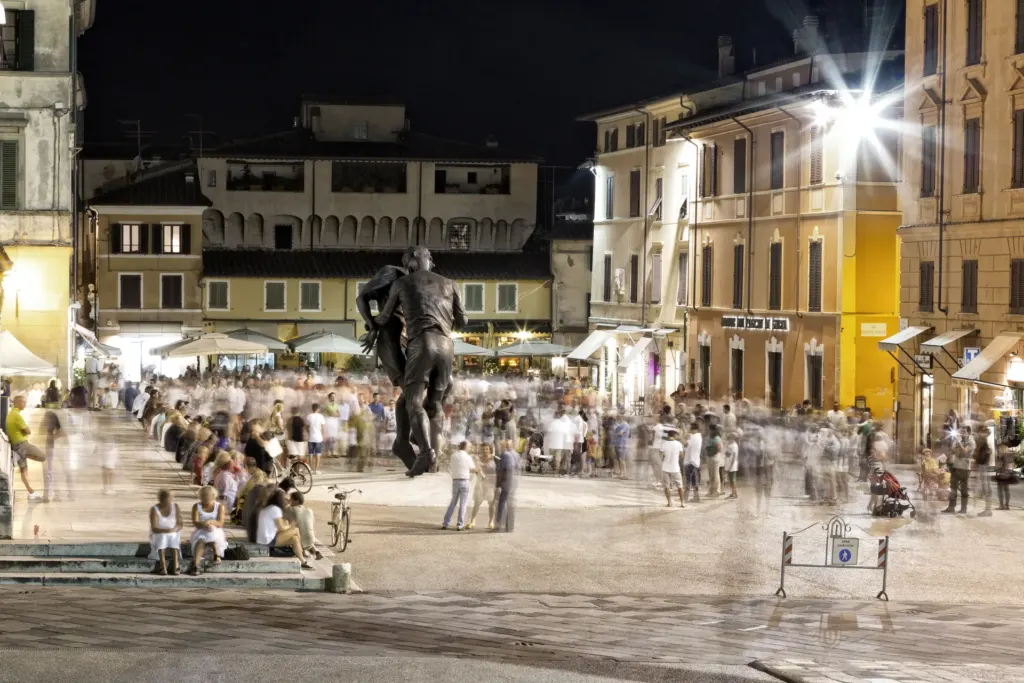
To find the sculptures without wandering aimlessly, there is the park’s free web app, with routes to follow on foot or by bike.
Workshops and foundries
Visiting a workshop is the experience that sets Pietrasanta apart from any other art town, and the one guidebooks explain least. In the marble workshops you can watch craftsmen rough out the blocks, copy models with the pantograph and finish the surfaces; in the foundries you can follow lost-wax bronze casting, from the wax model to the pour.
How to visit
Pietrasanta’s workshops are places of work, not museums: most accept visitors by appointment, on weekdays and during working hours. It is best to contact them beforehand to arrange a visit.
Good to know
Allow about an hour per workshop. Marble workshops are dusty and noisy: wear closed shoes and avoid dark clothes. Photographing works in progress is often not allowed, as they belong to the artists: always ask first.
The Rocca di Sala
From Piazza del Duomo, a walk uphill of about a quarter of an hour takes you to the Rocca di Sala, the fortress that towers over Pietrasanta. From up there you see everything: the rooftops, the bell tower, the Versilia plain all the way to the sea. It is the best spot for the sunset.
Down below, at the corner of the square towards Porta a Pisa, is the Rocchetta Arrighina, linked to the 14th-century walls. Don’t confuse the two: the Rocca di Sala and the Rocchetta Arrighina are different buildings.
Museums
Pietrasanta’s museums are small and quick to visit: together they fit comfortably into one day.
| Museum | What you’ll find | Time |
|---|---|---|
| Museo dei Bozzetti | Models of the sculptures made in the workshops of Versilia | 45 min |
| Museo Archeologico Versiliese | In Palazzo Moroni, on the square: finds from prehistory to the Middle Ages discovered in Versilia | 30 min |
| Carducci’s birthplace | In Valdicastello, a hamlet of Pietrasanta: the poet’s house museum | 30 min |
Opening times, closing days and tickets vary with the season: check them on the Municipality of Pietrasanta website before you go.
What to do in Pietrasanta in a day
To see Pietrasanta in a day, follow this walking itinerary, from morning to sunset.
- 9.30The Peace Frame and Via Mazzini, stopping at the Misericordia church for Botero’s frescoes.
- 10.30Piazza del Duomo: the cathedral, the bell tower, the Baptistery and the Torre delle Ore.
- 11.30Sant’Agostino and the Museo dei Bozzetti.
- 12.15The Mitoraj Museum, at Via Oberdan 35, in the former municipal market: open since 6 June 2026.
- 13.30Lunch in the centre, between the square and Via Mazzini.
- 15.00A marble workshop or a foundry, by appointment.
- 17.00The sculptures in the park, on foot or by bike, and the galleries.
- 19.00The walk up to the Rocca di Sala for the sunset.
- 20.30Aperitivo and dinner in the square, while the galleries stay open.
With two days, add Valdicastello and a morning at the beach in Marina di Pietrasanta.
Through the year
Pietrasanta changes a lot with the seasons. In summer the centre is full of exhibitions, the galleries stay open late, and at the Marina the Versiliana park hosts its festival, with talks and evening shows. In spring and autumn the town is quieter, and it is the best time for the workshops, which are working at full pace.
| When | What happened |
|---|---|
| Every month | Antiques market on the first Sunday of the month, in the centre |
| Summer | DAP Festival (dance) and Pietrasanta in Concerto (classical music); major sculpture exhibitions in the square and at Sant’Agostino; the Versiliana festival at the Marina |
| November | The San Martino fair, for the patron saint, with a market in the historic centre |
Around Pietrasanta
The municipality of Pietrasanta stretches from the hills to the sea. In Valdicastello, on the road to the Apuan Alps, is the birthplace of Giosuè Carducci. On the coast is Marina di Pietrasanta, with its beaches, beach clubs and the Versiliana pine wood: we cover it in our guide to the beaches of Marina di Pietrasanta. Pietrasanta is also a stage on the Via Francigena, which crosses it between Massa and Camaiore. For Forte dei Marmi, Lucca and day trips, see our guide to things to see in Versilia.
Practical tips
Cars and parking. Parts of Pietrasanta’s historic centre are a limited traffic zone: leave the car in one of the car parks around the centre and carry on on foot, they are all a few minutes from the square. On summer Saturday evenings and market days they fill up early.
From the relais. The centre of Pietrasanta is a few minutes’ drive from Relais Villa Isabel; the station is five minutes by taxi. The town and the sea fit nicely into the same day.
Where to eat. The historic centre is full of restaurants, trattorias and pizzerias, almost all of them good: the best way to choose is to stroll and look. Pietrasanta is at its best in the evening, with dinner, a stroll and an ice cream in the square. Our recommendations, from pizza to fine dining, are in our guide to restaurants in Pietrasanta.
When to go. May, June and September are the best months to visit Pietrasanta: pleasant warmth, exhibitions open and fewer people. In August the evenings are very crowded: book if you want dinner in the square.
Frequently asked questions
Why is Pietrasanta called Little Athens?
Pietrasanta is called Little Athens because of the many sculptors and artists who for centuries have come to work Apuan marble and bronze in its workshops. Many, like Botero and Mitoraj, lived here and left works in the town.
What is there to see in the centre of Pietrasanta?
The centre of Pietrasanta has Piazza del Duomo with the Cathedral of San Martino and its bell tower, Sant’Agostino and the Museo dei Bozzetti, Botero’s frescoes in the Misericordia church, the Peace Frame in Via Mazzini and the Rocca di Sala.
What to do in Pietrasanta in the evening?
In the evening in Pietrasanta you have dinner in the centre, stroll past the galleries, which stay open late in summer, and have an ice cream or a drink in Piazza del Duomo. At weekends it is best to book your restaurant.
What can you see in Pietrasanta in one day?
One day in Pietrasanta: the centre and museums in the morning, a marble workshop and the outdoor sculptures in the afternoon, the sunset from the Rocca di Sala and the square in the evening.
How far is Pietrasanta from the sea?
The historic centre of Pietrasanta is inland; the sea is at Marina di Pietrasanta, the town’s coastal district, a few kilometres and a few minutes’ drive away.
Can you visit the marble workshops?
Yes, many of Pietrasanta’s marble workshops accept visits by appointment on weekdays: it is best to contact them beforehand.
Where to stay when visiting Pietrasanta?
To visit Pietrasanta, a quiet base between the centre and the sea works best. Relais Villa Isabel is a B&B with a pool and garden among the olive trees, near Marina di Pietrasanta and a few minutes from the centre.
More guides to the area
- Marina di Pietrasanta and the seaThe areas, the beach clubs, the free beach and tips on choosing
- Things to see in VersiliaForte dei Marmi, the Apuan Alps, Lucca, Pisa and the Cinque Terre
- Exhibitions and events at the relaisPietrasanta’s art, inside the house too