Home / Surroundings / Things to see in Forte dei Marmi
Things to see in Forte dei Marmi
The Fortino, the pier, the Wednesday market, the villas of Roma Imperiale, Vittoria Apuana and the dunes: what to see and do in Forte dei Marmi, with a one-day itinerary.
In this guide
At a glance
- Forte dei Marmi is the seaside town just north of Marina di Pietrasanta, with the Apuan Alps behind it.
- Don’t miss: the Fortino in Piazza Garibaldi, the pier at sunset, Villa Bertelli and the historic villas of Roma Imperiale.
- The market is held in Piazza Marconi every Wednesday of the year and, from Easter to the end of October, on Sunday mornings too.
- The town is completely flat and easy to get around by bike: it is one of the cycle-friendly municipalities recognised by FIAB, the Italian cycling federation.
- From Relais Villa Isabel it is a few minutes’ drive.
Forte dei Marmi is the most elegant resort in Versilia: a small, completely flat town, with its centre gathered around the Fortino, a long, well-kept beach and villas hidden in the pine woods. You can see it in a day, on foot or by bike, and it makes more sense once you know its history: the name comes from the fort built at the end of the 18th century on the landing stage from which Apuan marble was shipped.
The Fortino
The Fortino of Forte dei Marmi, also known as the Forte Lorenese, is the building that gave the town its name. It was built in 1788 at the behest of Leopold I, Grand Duke of Tuscany, to defend the coast from pirates and protect the marble landing stage. It has a square plan with corners bevelled towards the sea, three floors and two turrets: one held the flag, the other was used to signal danger with smoke.
The Fortino stands in Piazza Garibaldi, which at the time was the square where marble and goods arriving from the hills were traded. Over the years it has been a customs warehouse, a barracks and lodgings; today it is a venue for exhibitions and events. The square also has the well from 1842, which supplied ships with water, and the fountain from 1900 bearing the coat of arms of Pietrasanta: until 1914 Forte dei Marmi was part of the municipality of Pietrasanta, and became a municipality in its own right on 26 April 1914.
The squares in the centre
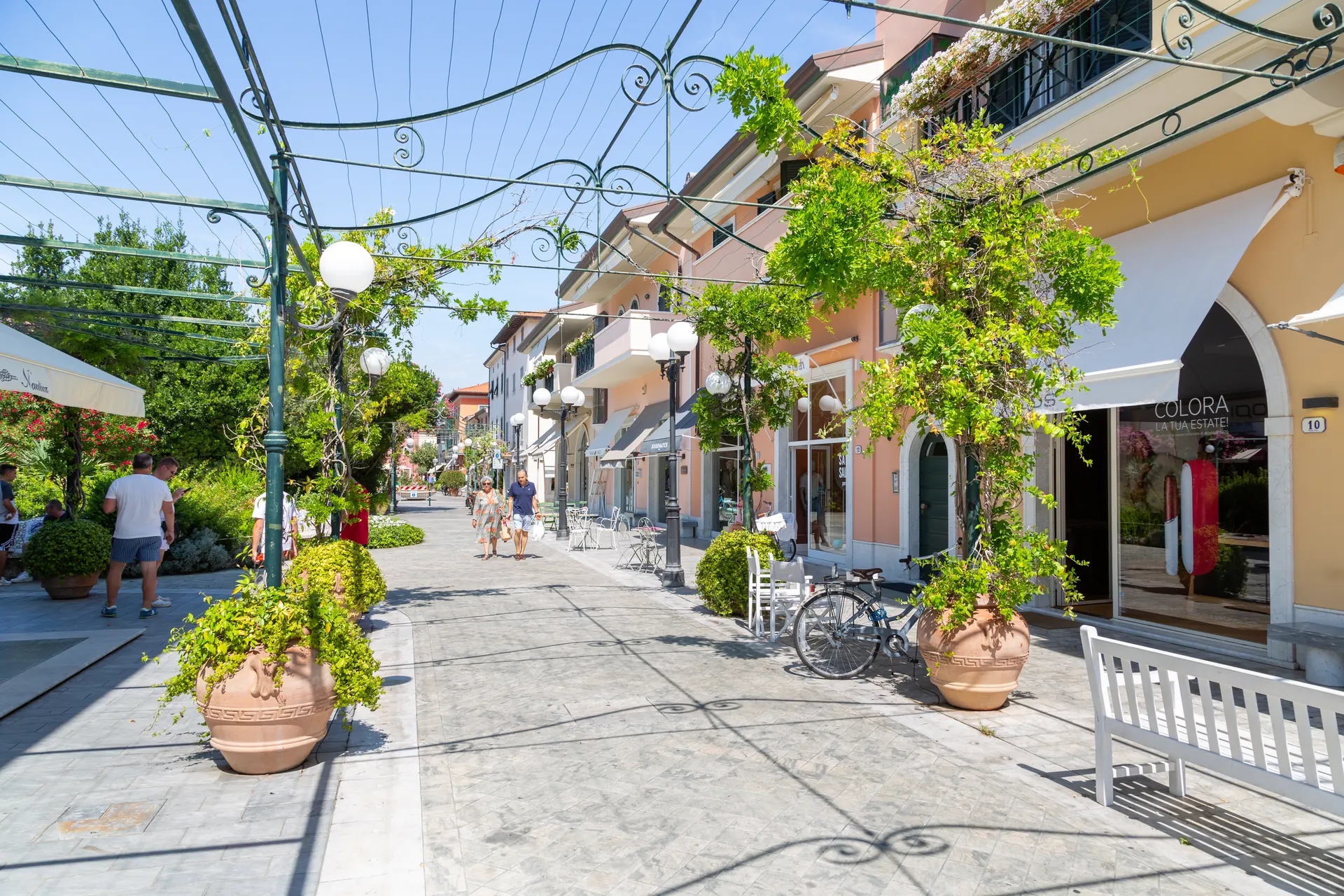
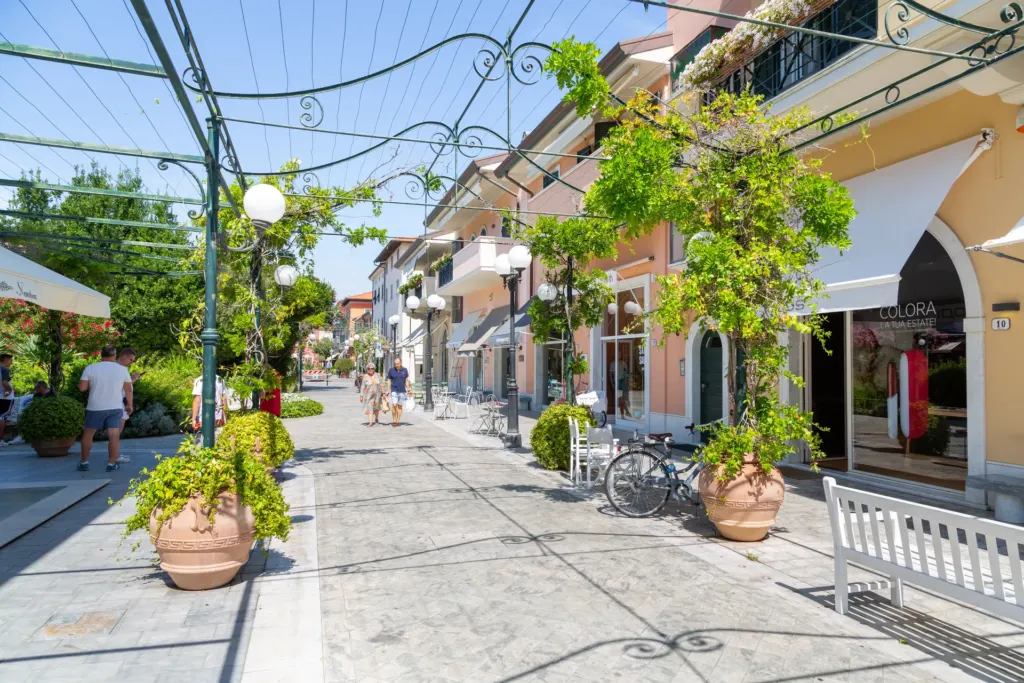
You can walk around the centre of Forte dei Marmi in an hour, between Piazza Garibaldi, Piazza Marconi and Piazza Dante. The surrounding streets are full of boutiques, galleries and cafés, and in summer they stay lively until late in the evening.
- The Victory monument, just outside the Fortino, is by the sculptor Arturo Dazzi (1937). The marble basin at its foot was the trough for the oxen that hauled the stone from the mountains to the sea.
- Piazza Marconi is the large ring among the pines where the market is held; in the middle there is a children’s playground.
- Piazza Dante is home to the town hall, in a building from 1922, and the war memorial. The gardens host a monthly antiques market.
- The church of Sant’Ermete, dedicated to the town’s patron saint, was built in 1890 and has been a parish church since 1911.
The pier
The pier in Forte dei Marmi is the best place in town to watch the sunset: from the end you can see the sea on one side and the Apuan Alps on the other. It began as a loading pier, for putting blocks of marble on ships once loading them from the beach was no longer enough. At the end stood a large iron crane, the “Mancina”, installed in 1877.
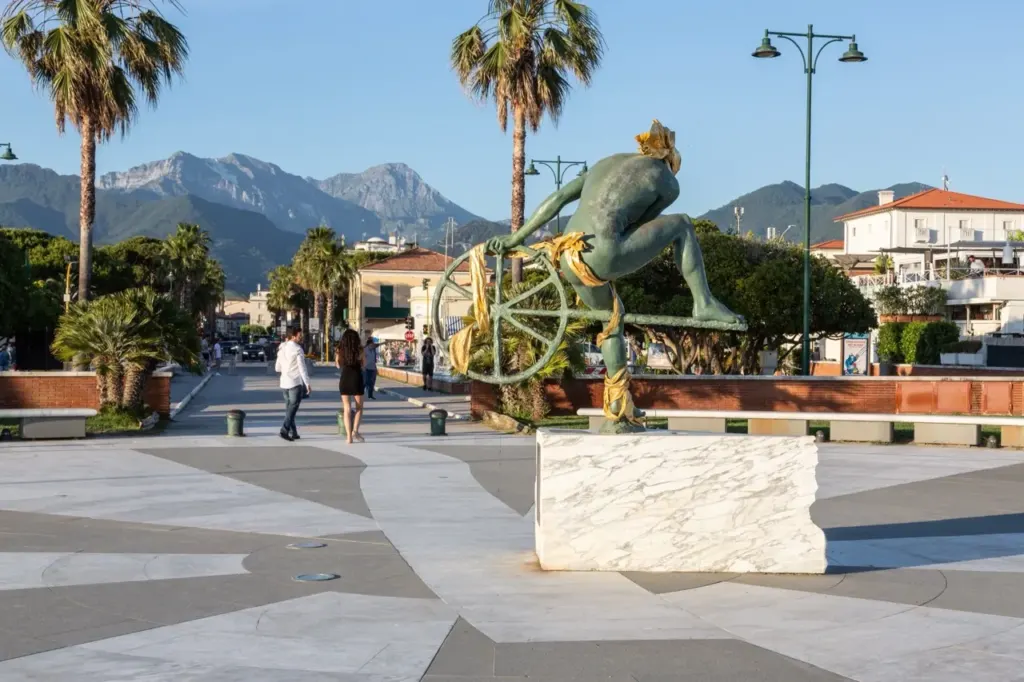
In September 1943 the pier was destroyed and the Mancina ended up in the sea. Its remains, recovered by divers from 1986 onwards, became the monument to the workers of the sea, unveiled in 1995 near the entrance to the pier.
The market
The Forte dei Marmi market is the most famous in Versilia: dozens of stalls selling clothes, cashmere, leather goods, shoes, household linen and ceramics, in Piazza Marconi, under the pines. It is not a bargain market: it is known for quality and for collections you can only find here.
| Market | Where | When |
|---|---|---|
| Weekly market | Piazza Marconi | Every Wednesday of the year, 8 am to 1.30 pm |
| Sunday market | Piazza Marconi | Every Sunday from Easter to the end of October, 8 am to 1.30 pm |
| Food market | Piazza Donatori di Organi | Every Wednesday of the year, 8 am to 1.30 pm |
| Vittoria Apuana market | Via Mazzini, Vittoria Apuana | Every Friday from June to September, 8 am to 1.30 pm |
| Antiques market | Piazza Dante | The weekend of the second Sunday of the month |
| Farmers’ market | Piazza Donatori di Organi or Via Assisi | Every Sunday, 8.30 am to 1 pm |
Times and dates are those published for 2026 by the Municipality of Forte dei Marmi on visitforte.com: check them before you go. On summer Wednesdays it pays to arrive early and leave the car away from the centre, or come by bike.
Beware of a common mix-up: many searches for the “Forte dei Marmi market” are about the Forte dei Marmi travelling traders, a consortium of stallholders who take their stalls to squares in other Italian cities. The original market, the one described here, is only held in the town itself.
The beach
The beach at Forte dei Marmi is one of the best kept in Italy: fine sand, shallow water, historic beach clubs with cabanas instead of umbrellas and attentive service. According to the municipality, the sea has held the Blue Flag for over thirty years. Almost the whole coast is taken up by beach clubs, and a front-row umbrella in August is among the most expensive in Versilia.
For a simpler day at the beach, the beaches of Marina di Pietrasanta are just to the south, with the Versiliana pine wood behind them: you will find them in our guide to the beaches of Marina di Pietrasanta, while the free beaches along the whole coast are in the guide to the beaches of Versilia.
Vittoria Apuana
Vittoria Apuana is the northern part of Forte dei Marmi, towards Cinquale: tree-lined avenues, villas set in greenery and a quieter pace than the centre. This is where the town’s two cultural venues are.
Villa Bertelli
Villa Bertelli was built in 1896 as the base of an explosives factory serving the Apuan quarries, with its own pier for shipping goods. In 1926 Ilio Bertelli turned it into a hotel, which closed in 1971. The municipality bought and restored it in 2002: today it is a cultural centre open all year, with the Quarto Platano modern art museum, exhibitions, talks and, in summer, concerts in the open-air theatre in the park.
The Ugo Guidi Museum
The Ugo Guidi Museum is the house in Via Civitali where the sculptor lived until 1977. It holds his sculptures and drawings and regularly hosts contemporary art exhibitions.
The church of San Francesco
The church of Vittoria Apuana, built between 1926 and 1933, is decorated with Apuan marble. In the forecourt stands a 1962 sculpture by Arturo Dazzi carved from a single block of marble: Saint Francis talking to the wolf.
The dunes
The dunes of Forte dei Marmi are the last stretch of coast left as it was before the beach clubs: sand, Mediterranean scrub and coastal plants that are increasingly rare. The area, on the northern edge of town, has been looked after for over twenty-five years by the municipality together with WWF volunteers, who also run guided walks; inside there is a small botanical garden. Access points are few and controlled, to protect the dunes.
Roma Imperiale
Roma Imperiale is the district of historic villas in Forte dei Marmi, south of the centre: a garden city built in the 20th century, with large houses set in pine woods, quiet avenues and tall hedges. The villas are private and can only be seen from outside; the best way to explore them is by bike, in the cooler hours.
The artists of Forte
In the first half of the 20th century Forte dei Marmi was a meeting place for artists and writers: Carlo Carrà, Arturo Dazzi, Ardengo Soffici, Lorenzo Viani and others gathered at the Quarto Platano café, on the square of the Fortino. Carrà painted the town and its beach for many years: a cycling route marks the spots where he painted them with reproductions of the pictures.
The link with art continues in Pietrasanta, a few kilometres away, the city of sculptors and marble workshops: find out more in our guide to things to see in Pietrasanta.
By bike
Forte dei Marmi is made for cycling: the area is small and completely flat, and since 2020 the town has been a cycle-friendly municipality for FIAB, with four “bicycles” out of five in 2025. The seafront cycle and footpath links Vittoria Apuana to the centre and is part of the route that runs through the whole of Versilia.
From Relais Villa Isabel you drive to the sea at Marina di Pietrasanta, a few minutes away, and from there follow the seafront avenue to the pier in Forte.
A day in Forte dei Marmi
To see Forte dei Marmi in a day, choose a Wednesday or, in summer, a Sunday, so you can take in the market too.
| Time | What to do |
|---|---|
| 9.00 | The market in Piazza Marconi, before the crowds arrive |
| 11.00 | The Fortino, Piazza Garibaldi and the streets of the centre, as far as Piazza Dante |
| 12.30 | Lunch at a beach club by the sea |
| 15.00 | Cycle to Vittoria Apuana: Villa Bertelli, the church of San Francesco and the dunes |
| 18.00 | The villas of Roma Imperiale, on the way back |
| 19.30 | Sunset on the pier, then an aperitivo and dinner in the centre |
In the evening
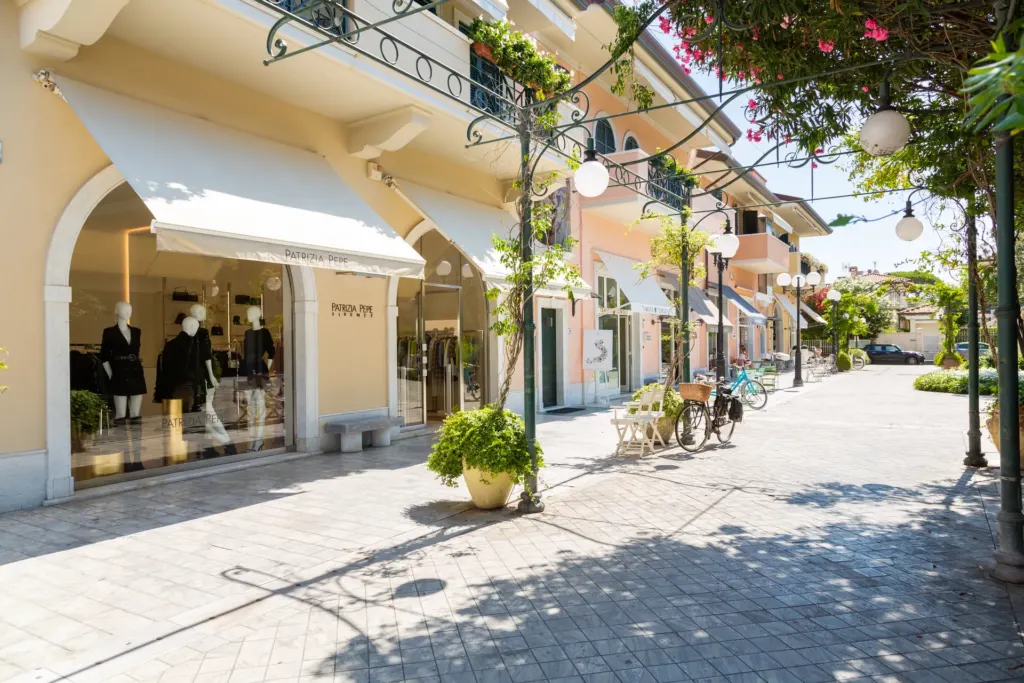
In the evening Forte dei Marmi is more elegant than loud: people stroll through the centre past the open shop windows, have dinner on the seafront or in the trattorias inland, and in summer Villa Bertelli and the Fortino host concerts and talks. The clubs for dancing are mostly along the seafront avenue. For a livelier night out there is also Focette, in Marina di Pietrasanta.
Frequently asked questions
What can you see in Forte dei Marmi in one day?
In one day in Forte dei Marmi you can see the Fortino and the squares of the centre, the market in Piazza Marconi if it is a Wednesday or Sunday, Villa Bertelli and the dunes at Vittoria Apuana, the villas of Roma Imperiale and the sunset from the pier. The easiest way to get around is by bike.
What day is the market in Forte dei Marmi?
The Forte dei Marmi market is held in Piazza Marconi every Wednesday of the year, from 8 am to 1.30 pm, and from Easter to the end of October on Sunday mornings too. In summer there is also a Friday market in Vittoria Apuana.
Why is it called Forte dei Marmi?
Forte dei Marmi (“Fort of the Marbles”) takes its name from the fort built in 1788 by Grand Duke Leopold I on the landing stage from which marble from the Apuan Alps was shipped. The Fortino still stands in Piazza Garibaldi, in the middle of town.
Can you go to the beach for free in Forte dei Marmi?
In Forte dei Marmi almost the whole beach is taken up by beach clubs, but the shoreline is public and you can always reach the sea. The stretches of free beach along the coast are listed in our guide to the beaches of Versilia.
Where to stay near Forte dei Marmi?
If you want peace and quiet a few minutes from Forte, it is best to stay just outside town. Relais Villa Isabel is a B&B with a pool and garden between Pietrasanta and the sea, with private unattended parking, a few minutes’ drive from the coast.
More guides to the area
- The beaches of Marina di PietrasantaThe areas, the beach clubs, the free beach and tips on choosing
- Things to see in PietrasantaThe historic centre, the Bozzetti museum, Botero and the marble workshops
- Things to see in VersiliaFrom the coast to the Apuan Alps, with day trips